Within this project stage we have developed a cold plasma reaction cell, which allows us to treat / activate a large palette of liquids and / or materials in the form of nanopowder. It was necessary to expand to the possibility of treating liquids as well, because in the real conditions of use in a chemistry laboratory, very often nano-materials (nanoparticles) are presented in colloidal form in suspension in a liquid.
The reaction cell developed in this step is specially constructed to treat with cold plasma (electrical discharge) any non-flammable liquid (or flammable liquid with the blowing of an inert gas). The aim is to provide users with a fast, versatile, simple and robust system for the activation/disinfection/chemical processing of a large class of liquids and/or nano-materials, in the shortest possible time, with high efficiency.
The reaction cell is intended especially for use in chemistry laboratories and/or in liquid chemical processing facilities.




 
 
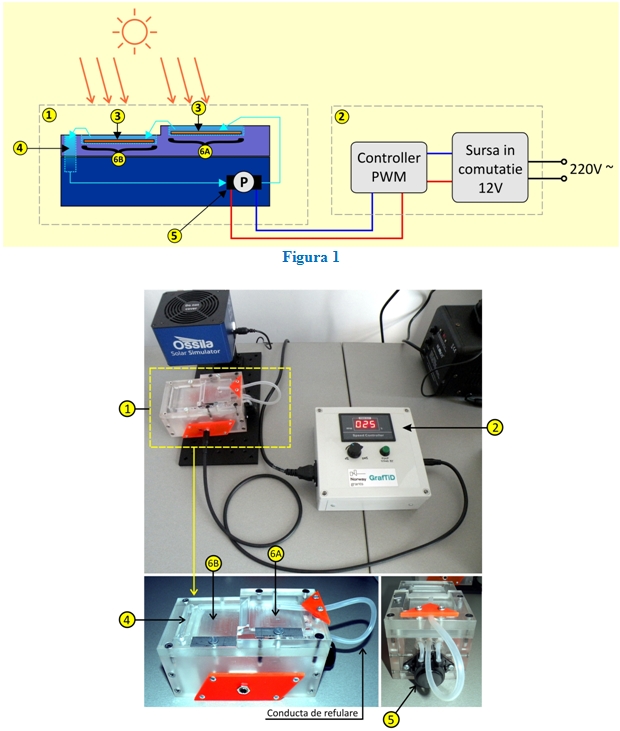
Additional result: working laboratory model - micro facility for experimental studies of photocatalysis .
The purpose of the design and construction of this laboratory model is to obtain a self-contained micro research facility for studying the photodegradation of 17β-estradiol and acetaminophen.
The technical problem that the present invention solves is related to providing an autonomous, easy-to-use facility that can be used in laboratories to research methods for the total removal of 17β-estradiol or partial acetaminophen, using the photocatalytic activity of nanocomposites formed from nanotubes of TiO2, platinum and graphene nanoparticles, immobilized on a polymer surface.
The photodegradation experiments carried out in discontinuous mode and with the catalyst in the form of a suspension lead to poorly reproducible results. This laboratory model proposes carrying out continuous photodegradation experiments with the catalyst immobilized on a solid surface, using an installation consisting of: a stand for photocatalysis (photodegradation) (1), the power source of the recirculation pump (2), the speed (flow) control circuit (5) and the photoactive material immobilized in the form of a plate (3).
The stand for photodegradation (1) was designed with the idea of reproducing in the laboratory on a small scale (as real as possible), the mechanism of photodegradation in the natural environment, for example: an artificial settling pond used for water purification.